Invertibility and parity in symmetric monoidal categories
Note: This was first posted as a mathstodon thread, and archived here.
Nick Gurski and I have a new paper out, about another coherence problem!
Invertibility and parity in symmetric monoidal categories https://arxiv.org/abs/2604.15142
For someone who doesn't enjoy coherence theorems, I seem to spend a lot of time on them. This one is about coherence for invertible objects in a symmetric monoidal category, using an invariant that we call parity.
In the thread below, I'll explain
- what our main results say, in a few different ways,
- what technology we use to prove them (spoiler: it's 2-monads, again), and
- a few different examples, including one that is nontrivial.

Note: This picture is a crop of the cover art by Pablo Delcan for Jeff VanderMeer's book Annihilation. The book is sort of related to coherence, in a non-mathematical sense, and anyway I liked it. That boar looks like it knows a thing or two about invertible objects.
Main ideas
To explain the main ideas in our paper, consider a symmetric monoidal category (A,+,0,β). So, the monoidal sum is denoted +, the monoidal unit is denoted 0, and the braiding (a.k.a. symmetry) is denoted β. We assume that the unit and associativity isomorphisms are identities, so the monoidal structure is strict.
An invertible object x in A has a weak inverse, x', with morphisms ε:x+x' ≅ 0 (cancel) and η:0 ≅ x'+x (decancel) satisfying triangle identities that make the functors x+(-) and x'+(-) adjoint inverse equivalences.
Using the braiding, β, each invertible x gives us an automorphism of the unit
0 -η-> x'+x -β-> x+x' -ε-> 0
This composite is sometimes called the trace of 1ₓ or the Euler characteristic of x. We call it the figure eight on x and write 8ₓ because the string diagram looks like a figure eight.
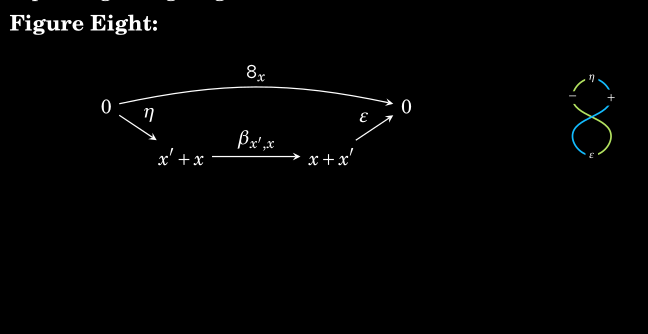
screenshot showing the figure eight in both arrows and string diagram notation
Main theorem (version 1)
One version of our main theorem can be explained in Pₓ, the free symmetric monoidal category on an invertible object x. It says that morphisms in Pₓ are characterized by the parity of how many instances of 8ₓ they have.
In particular, the composite or sum of two figure eights is the identity! Our fantastic choice of notation expresses this fact as follows:
8ₓ∘8ₓ = 8ₓ+8ₓ = 1₀.
So, this fact implies that any composite or sum of figure eights can be reduced to just odd or even. The main theorem says, moreover, that every morphism in Pₓ boils down to some composite or sum of figure eights. A little later in this thread I'll give some more precise (more comprehensible) versions of the same result.
[Aside: I want to pause and note that this might sound familiar to some readers, because these facts have been known in some form or other for a long time. They are very well studied! Our paper has a "Relation to Literature" subsection that addresses some of this, and I'll make some further comments below, but this thread is mostly for people who haven't seen it before, or have seen it but would like to see an alternative explanation because it's neat.]
Figures C and H
Before that, here's an example of two other composites that might appear different but are actually equal to each other and to the figure eight. We call one Cₓ, the figure C, and the other Hₓ, the figure H, since the string diagrams sort of look like those letters.
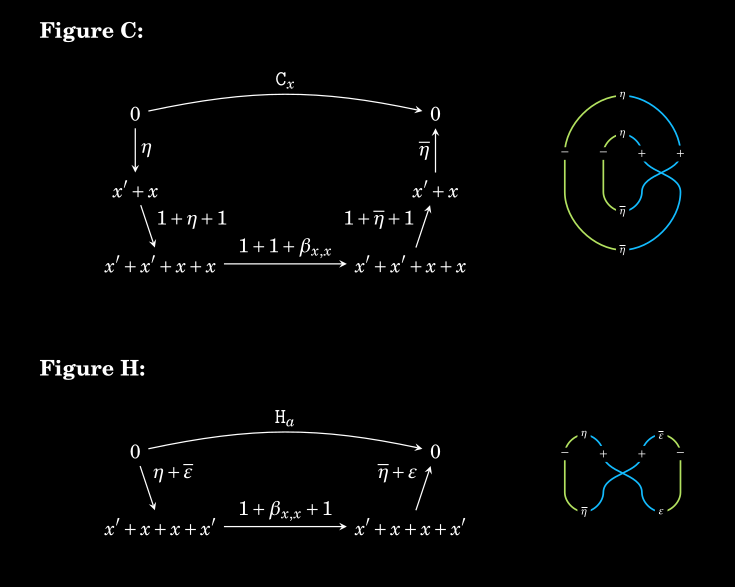
screenshot showing the figure C and figure H in both arrows and string diagram notation
So, Cₓ and Hₓ also have odd parity, because they're each equal to one instance of 8ₓ. Not pictured: There is also a "reverse C" that uses the braiding of x' with itself, and a figure eight on x' that reverses the roles of x and x'. Both of these are also equal to 8ₓ = Cₓ = Hₓ, and therefore have odd parity.
<2 id="org0897483">Main theorem (version 2)As often happens, our main theorem is a little easier to state with some additional background. I'll add that now.
In Pₓ, the free symmetric monoidal category on the invertible object x, the morphisms are generated as sums and composites of six basic morphisms, with the following parities:
There are two de/cancel morphisms, and they have even parity: ηₓ: 0 → x'+x εₓ: x+x' → 0
Then, there are four basic braiding morphisms βₚ,ₛ: p+s → s+p where s and p are each either x or x'; each of these has odd parity.
These parities follow from the parities of the "figure morphisms", 8, C, and H above. Then, parity for any other morphisms in Pₓ are computed from these: parity is additive on sums or composites of morphisms. Our main theorem says that any parallel morphisms with the same parity are equal.
The Super Integers
With even more background, I can give an even easier statement of our main theorem, and finally an explanation of how it's proved. The required background involves a cute little category that we call the Super Integers. This is a symmetric monoidal category, Z, whose objects are the integers, and where each object has two automorphisms called "odd" and "even" or denoted ±1; that's the "super" part. There are no morphisms between non-equal objects.
[Aside: yes, this name is too hip, but I've come to terms with it.]
You can think of the Super Integers like the integers with "virtual permutations": it's symmetric monoidal, so you can make sums and permute summands, but each permutation is characterized only by its sign. (These generating objects could also be denoted ±1, but then I get confused by having the same notation for objects and morphisms, so I'll avoid that here!!)
Main theorem (best version)
The shortest version of our main theorem is that there is an equivalence of symmetric monoidal categories K: Pₓ → Z, where Pₓ is the free symmetric monoidal category on one invertible object x. Moreover, this equivalence K does the following on generating morphisms:
The de/cancel morphisms ηₓ and εₓ are sent to identities. The four braidings βₚ,ₛ (for p,s ∈ {x, x'}) are sent to odd morphisms in Z.
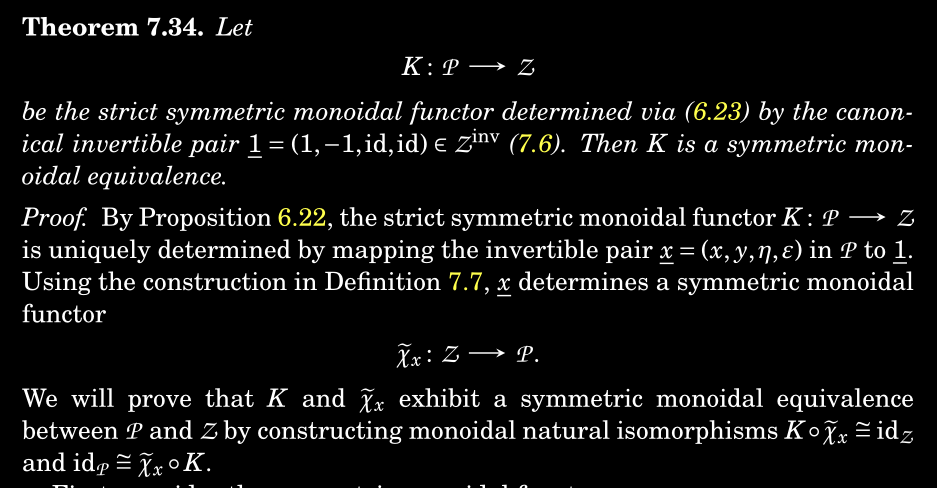
Statement of Theorem 7.34 from the paper. It's a more formalized version of the explanation below.
This is the version we prove, and it's the one that isn't part of the previous literature. It's also the one with our favorite conceptual interpretation: in Pₓ you have a formally constructed object that, by design, has a free universal property. So, Pₓ is easy to work with in abstract or general terms. But—as often happens with universal constructions—Pₓ is a big complicated mess of objects and morphisms. So, it's hard to tell whether two morphisms (such as two ways around a diagram) are equal or not.
On the other hand, Z is so simple it can be explained in a couple of paragraphs. Coherence in Z is so easy you don't even have to think about it. But—because Z is so simple—it's not something that appears "in nature". The examples that made people want to know about invertibility, like invertible modules over a ring or virtual vector spaces, almost never have identities for their de/cancel (i.e., unit/counit) morphisms.
So, the equivalence K explains how to take interesting diagrams in Pₓ and convert them to easy diagrams in Z. Then you can use parity of morphisms there to determine whether the diagrams commute.
2-monads
The way we prove our main theorem uses some abstract 2-monad theory going back to Blackwell-Kelly-Power (flexibility of monads), and also Lack's model structure on 2-monads. I'll certainly leave those details to the paper, but they're not that hard. We've structured it so that you just need to understand the statements we've extracted, and then apply them as black boxes.
This isn't the first time some wildly general 2-monadic algebra has been applied for concrete, computational applications; I think those applications are how people got into abstract 2-monad theory in the first place! I think our application is another neat one for those who are interested in such things.
Example
We put a bunch of examples in the last section of our paper, starting with some of those figure morphisms and gradually building up to more complex examples. Here, I'll just give the final one, because it illustrates a diagram that doesn't (generally) commute, but looks at first like it ought to.
To start, suppose a is an invertible object in a symmetric monoidal category A, with inverse a'. Then there is a conjugation functor Gₐ: A → A given by
z ↦ zᵃ = a' + z + a
You can show (using our coherence stuff) that this is a symmetric monoidal functor. Furthermore, you can show (again using coherence) that Gₐ is isomorphic to the identity on A. So, this is a categorification of the fact that conjugation in an abelian group is the identity homomorphism.
Of course, conjugation by a' is also a symmetric monoidal functor, and also isomorphic to the identity.
The example gets going when you realize that there is a natural isomorphism between these two, with components given by an isomorphism
a' + z + a ≅ a + z + a'
permuting the summands by a (1 3) permutation. So, is this a monoidal natural isomorphism? How could it not be??!
Well, here's the monoidal naturality diagram for two objects z and w:
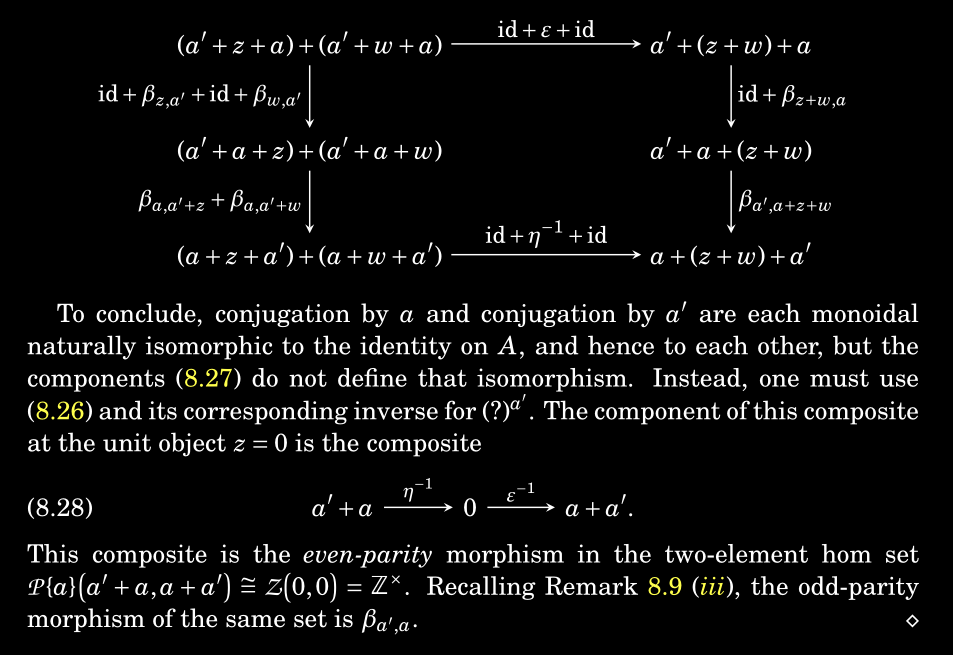
At top, the monoidal naturality diagram from the paper. It's a rectangle involving lots of letters. In the lower half, some explanation that is summarized below.
Checking the a-parity, one composite is even but the other is odd. So, the two composites around the diagram are not generally equal. In particular, they are not equal when z and w are the unit object, 0, and a is a free invertible generator.
The paragraph after the diagram gives this explanation: conjugation by a and a' are both symmetric monoidal functors, and are both monoidal naturally isomorphic to the identity. So, they are monoidal naturally isomorphic to each other, but the (1 3) permutation above is not that isomorphism. Instead, that isomorphism factors through the identity functor, so it involves just de/cancellation morphisms with no permutations of the object a past its inverse a'.
I think that makes sense in retrospect, but also could be a source of confusion. (It definitely was for me!! One day while we were working on this I sent Nick a sequence of increasingly frantic/confused emails, followed the next morning by a long explanation of how useful it is to get a good night sleep.)
Related literature
Finally, I want to conclude with a mention of the related literature. Monoidal categories where every morphism and every object is assumed to be invertible are sometimes called 2-groups. When the monoidal structure is symmetric, they're called symmetric 2-groups or Picard categories.
These have been studied a lot, for a long time. There are various coherence theorems in the literature, for both the non-symmetric and symmetric cases. Highlights include work of Laplaza [1], Baez-Lauda [2], Kelly-Laplaza[3], and Dugger [4]. (More detail in our "Relation to literature" subsection.)
So, why do we need another version some decade(s) later?? Well, one honest reason is that we had a hard time understanding the older versions. Even the more recent ones depend crucially on the early Laplaza and Kelly-Laplaza work. We tried to explain them in a way we could understand, and wound up with the independent (2-monadic) approach I mentioned above.
So here we are. Yes, serious people have known all about the essential computational facts for decades, but our version adds a nontrivial and (we think) useful perspective!
[1]: Laplaza, Coherence for categories with group structure: An alternative approach (1983) https://dx.doi.org/10.1016/0021-8693(83)90081-9
[2]: Baez-Lauda, HDA V: 2-groups (2004) http://tac.mta.ca/tac/volumes/12/14/12-14abs.html
[3]: Kelly-Laplaza, Coherence for compact closed categories (1980) https://dx.doi.org/10.1016/0022-4049(80)90101-2
[4]: Dugger, Coherence for invertible objects and multigraded homotopy rings (2014) https://dx.doi.org/10.2140/agt.2014.14.1055
tags: maybe-blog | social | papers


 The content of